
What is a geotextile tube? Uses, filling, and limits
What a geotextile tube does, how filling works, coastal and sludge dewatering uses, advantages, limits, and checks before choosing a tube for a project.
 Indramas Insight
A geotextile tube is a long tube of geotextile fabric, filled by pumping a mixture of water and solids into it. The fabric retains the fill while allowing water to escape through its openings. Geotube is a Solmax product name; geotextile tube names the category.
Sand-filled tubes form elongated masses for coastal erosion control. Tubes also contain sludge or dredged sediment for dewatering, the removal of water from wet material. These uses share the same principle, but place different demands on the fill, fabric, seams, and pumping.
In this article

How does a geotextile tube work?
The installer places the empty tube in its final position, then pumps in slurry, a mixture of water and suspended solids. The slurry expands the fabric into its filled shape. Water passes through the geotextile while the selected fabric holds back the solid particles.
Filtration depends on both opening size and permeability, the ability to transmit water. The right fabric retains the fill without excessively restricting water release. A seam is the joint between fabric sections; its strength matters alongside the strength of the fabric itself.
The fill gives the tube a flattened cross-section rather than a circular one. Its final height is less than the diameter of a circle with the same circumference. The designer accounts for this final height and width alongside the fabric and seam strength required during pumping.
Where are geotextile tubes used?
Coastal and shoreline protection
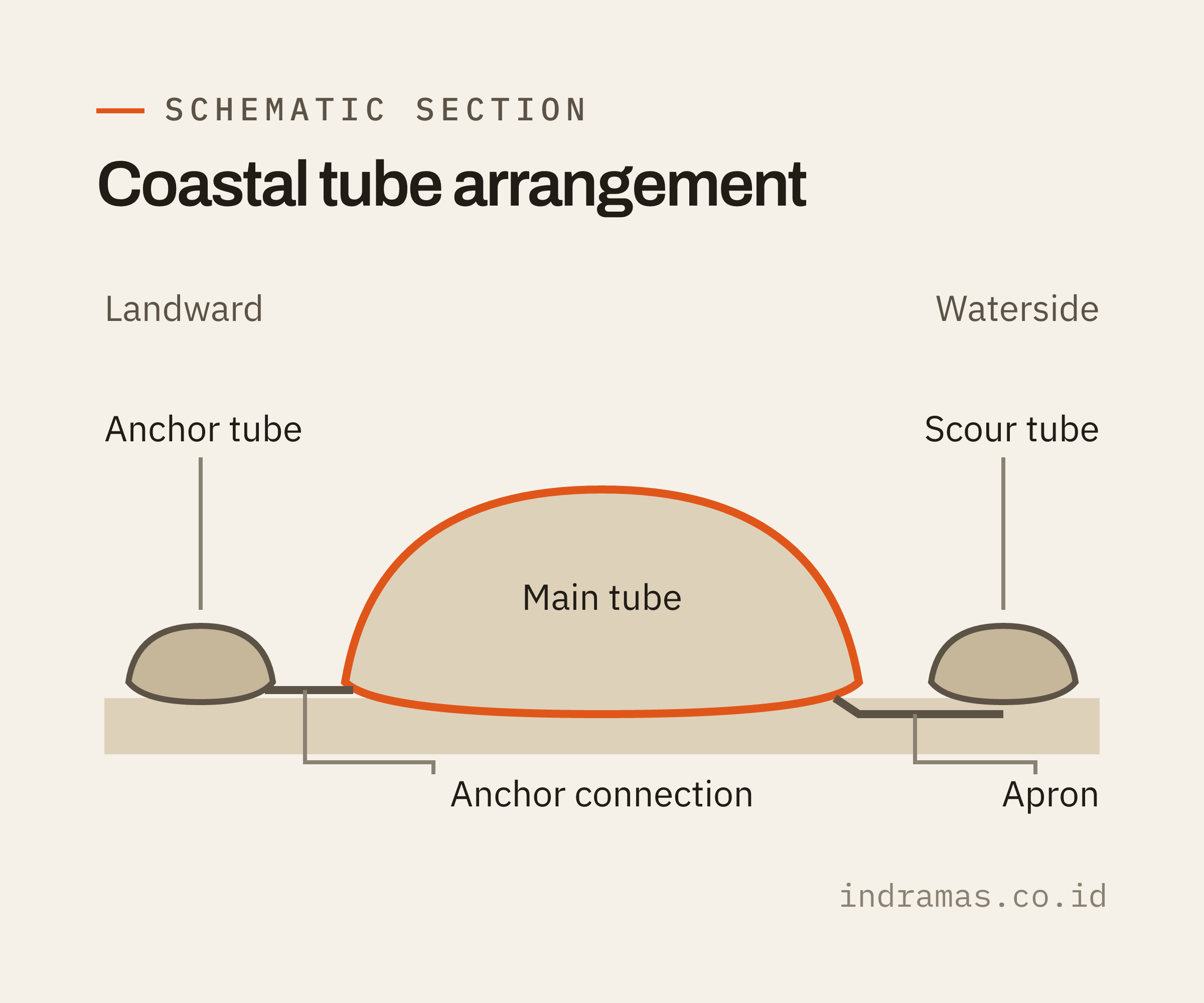
Sand-filled geotextile tubes protect shorelines against erosion. Dredged sand serves as fill when its particle sizes suit the fabric. The coastal arrangement includes more than the main tube: anchoring and protection against scour, the removal of ground material by moving water, also enter the design.
A landward anchor tube connects to the main tube. On the waterside, a scour tube and apron, a protective sheet extending along the ground, form part of the arrangement. Their dimensions, locations, and connections are design issues rather than a fixed layout for every shoreline.
Dewatering sludge and dredged sediment
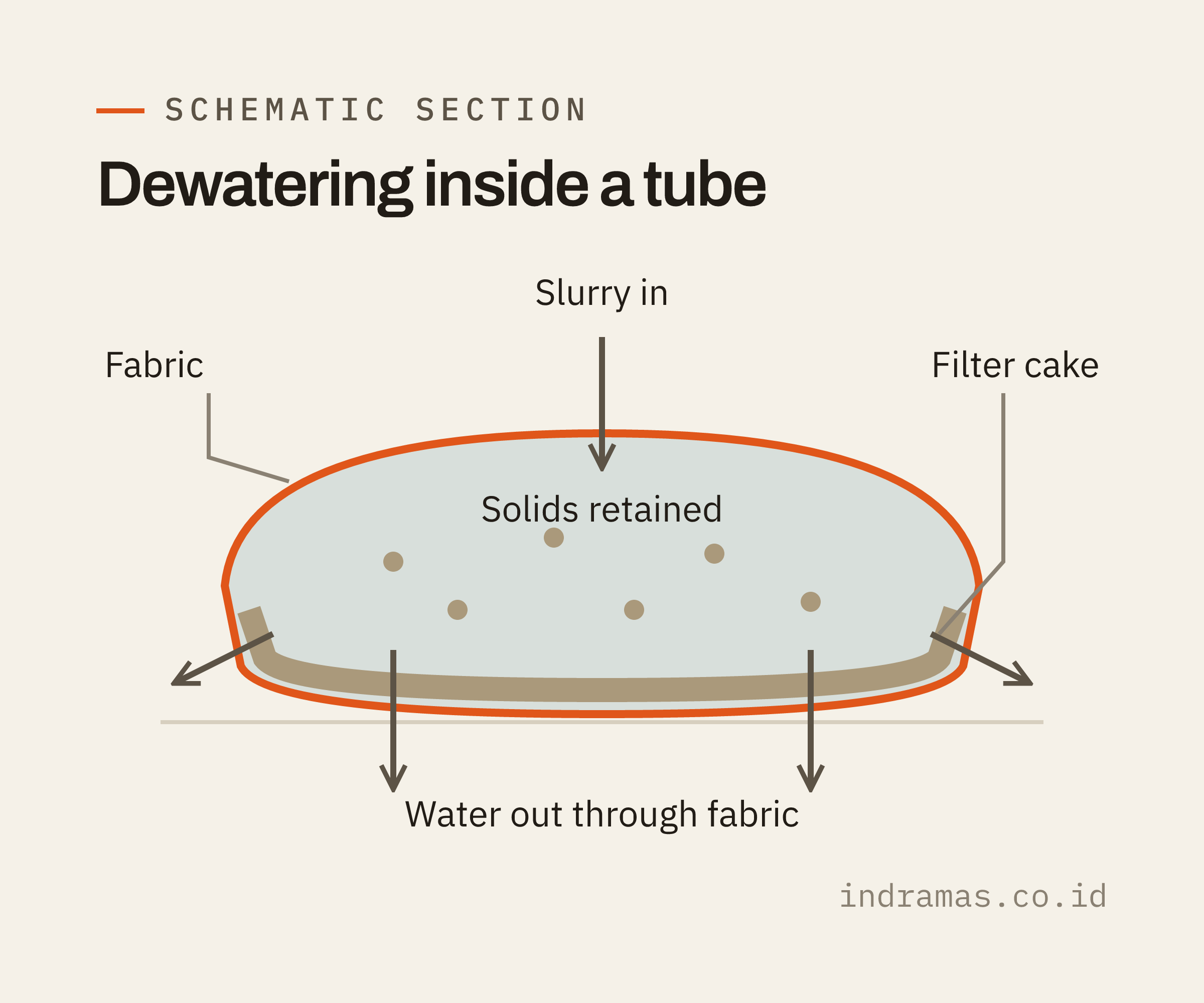
Dewatering applications include fine-grained dredged soils, industrial sludge, sewage-treatment sludge, and agricultural waste. The tube holds the wet material while water drains out through the fabric.
Fine solids form a filter cake, a layer of retained particles on the fabric’s inner face. Water passes through this layer as well as the geotextile.
What are the advantages?
Filling after placement
The installer can position the empty tube in a hard-to-reach location before adding the fill. The flexible fabric goes where a rigid form would be difficult to place. Flexible geotextile forms also work underwater, where the incoming fill displaces the water inside the form.
Using sand as a coastal protection mass
A tube confines sand in an elongated unit for erosion control. Dredged sand becomes useful as protective fill where it meets the fabric’s retention requirements. Particle size and fabric opening size determine whether that sand suits the tube.
Containing solids while releasing water
For dewatering, the same tube contains the solids and gives the water a route out. This benefit depends on matching the fabric to the sludge and accounting for the filter cake that develops inside.
What are the limitations?
Storms can move the filled tube
Intense storms can make the main tube sink into the ground or roll. Fill weight alone does not keep it in place. The designer assesses the anchor tube, scour tube, and apron connections as part of the coastal arrangement.
Pumping loads the fabric and seams
Pumping pressure loads both the fabric and its seams. Seams are typically the weaker element, so the designer checks their strength separately. The operator adjusts pumping to fill the tube as fully as possible and let the contents settle quickly without tearing the fabric or a seam.
Fabric openings must suit the fill
Openings that are too large let fill escape; too little permeability holds water back. The designer matches the fabric to the fill to balance particle retention with water flow. Fabric strength alone cannot compensate for a poor match.
Sunlight affects exposed fabric
Prolonged ultraviolet (UV) exposure reduces geotextile strength. UV stabilizers in the polymer slow this loss but do not stop it. Where the design allows, a sand or soil cover shields the fabric; timely backfilling limits its exposure.
Filter cake controls dewatering time
The filter cake has low permeability and slows water release. Its composition governs dewatering time, so tube size alone cannot predict the schedule. The sludge itself also limits how much water the process removes.
Water quality requires separate assessment
Sludge may contain hazardous pollutants or, in sewage-treatment sludge, microorganisms. Holding back solids does not make the outgoing water clean enough to discharge. The project team assesses what happens to these contaminants separately from how well the tube removes water.
How is a geotextile tube different from a geobag?
A geobag is an individual bag; a geotextile tube is one long, continuous unit. Both use flexible fabric to contain fill, but a tube is filled by pumping, so pumping pressure and the final shape get particular attention in its design. The geobag guide explains bag applications and limitations.
What to check before choosing a geotextile tube
Selection starts with the purpose and fill: coastal protection with suitable sand, or dewatering of a particular sludge or sediment. The checks cover particle retention, water transmission, fabric and seam strength, elongation (how far the fabric stretches before it fails), pumping, and final geometry. Coastal work also considers storm stability, anchoring, scour protection, and sunlight exposure. Dewatering assessment includes filter-cake behavior and the fate of pollutants and microorganisms.
For advice on choosing a geotextile tube, you can contact Indramas, which supplies Solmax GEOTUBE Marine and GEOTUBE Dewatering Containers.